
IQ test — four cognitive domains, scored with Item Response Theory.

No signup to start · An estimate, not a clinical score
- About 12 minutes
- Four domains
- Gets harder as you go
- Scored against norms
What the test measures
Four kinds of reasoning, not one
A single number hides more than it tells. The test samples four distinct abilities, because most people are markedly stronger in some than others — and that shape is the interesting part.
Pattern recognition
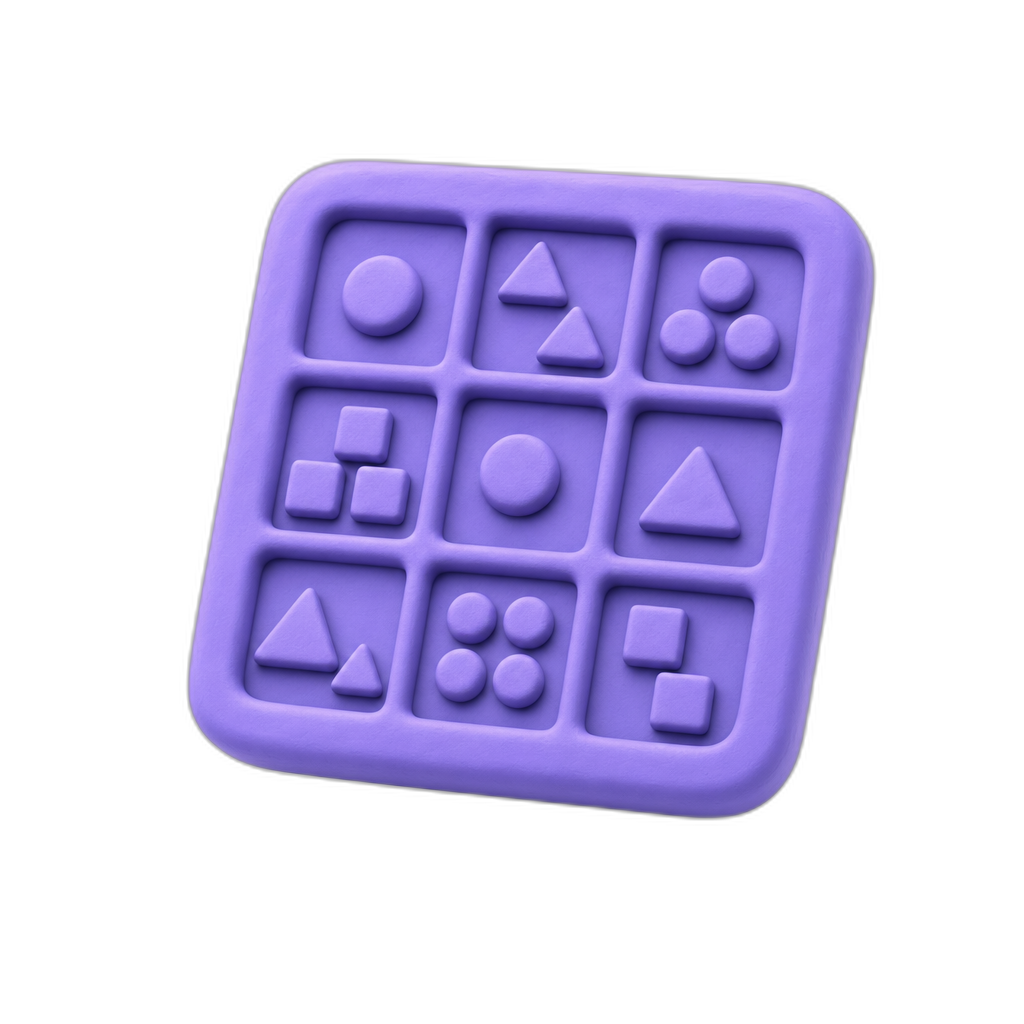
Progressive matrices in the Raven's tradition: a grid with one cell missing, and a rule to work out from the rest. Reasoning with no prior knowledge involved.
Numerical reasoning
Sequences, mental arithmetic and word problems, moving into proportional and algebraic reasoning at the harder end. Working with quantity, not recalling maths lessons.

Verbal reasoning
Analogies, vocabulary and a couple of genuine riddles. Semantic precision and lateral thinking, tested together rather than separately.

Emotional intelligence
Short social scenarios where you read the most likely feeling behind a behaviour. Descriptive only — a reading of social inference, never a label.
How the scoring works
A hard item is worth more than an easy one
Most online IQ tests count how many you got right. That treats a question almost everyone answers correctly as equal to one almost nobody does, which is why those scores drift so far from reality.
- 1
Every item carries its own parameters
Each question has a difficulty, a discrimination and a guessing parameter — how hard it is, how sharply it separates ability levels, and how often it can be answered correctly by chance.
- 2
Your ability is estimated, not counted
Item Response Theory works backwards from your particular pattern of answers to the ability level that best explains it. Two people with the same number correct can land in different places.
- 3
The estimate is placed against norms
That ability estimate becomes a standard score on the familiar scale, with a confidence range around it — because a twelve-minute test gives a range, and anyone who tells you otherwise is guessing.
At the end
A profile, not just a number
The results page shows your estimated composite range straight away. The full report opens up the exact figure and the shape underneath it.
- Your estimated cognitive index with a confidence range, not a false-precision single figure.
- A score for each of the four domains, so you can see where you are strong and where you are not.
- Where each domain sits against the population, as a percentile.
- A plain-language read of what that pattern of strengths tends to look like day to day.
- Your attempt kept in your dashboard, so a retest later shows the change rather than starting over.
The test is open to everyone — the full report unlocks for $12.99, one time, with a 30-day money-back guarantee.
Start the test
Questions people ask
Before you start
Is this a real IQ score?
It is an estimated cognitive index, not a clinical IQ measurement. A supervised assessment by a psychologist takes a couple of hours under controlled conditions and is the only thing that produces a formal score. This is a carefully built estimate from a twelve-minute test, reported with a confidence range so you can see how precise it is.
How long does it take?
About twelve minutes. There is a timer, because speed is part of what the test measures — but it is generous enough that nobody is rushed past items they could otherwise solve.
Why do the questions get harder as I go?
The items are ordered by difficulty, easiest first. You build momentum rather than hitting a wall on question two, and the harder items at the end are where the scoring gets most of its information about your ability.
Can I retake it?
Yes. Bear in mind that a second attempt usually comes out a little higher simply through familiarity with the format, which is true of every cognitive test. Your attempts are kept in your dashboard so you can see them side by side.
Do I need to sign up?
No. You can take the whole test without an account. The full report unlocks with a one-time payment, and you can create an account afterwards to keep it.
Cognitive index is an estimate for self-knowledge. Not a clinical IQ measurement. For clinical IQ assessment, consult a licensed psychologist.